
The short answer
Acetone is the simplest ketone. Formula C3H6O, structure CH3COCH3, CAS 67-64-1, molecular weight 58.08 g/mol, boiling point 56 °C, density 0.79 g/cm3.
Three properties explain almost every use it has. It dissolves a very wide range of organic materials. It is completely miscible with water. And it evaporates quickly and cleanly, leaving no residue. The cost of that last property is a flash point of about −20 °C, which means every drum, line and tank has to be treated as a flammable liquid installation.
Formula, structure and identifiers
| Property | Value |
|---|---|
| Molecular formula | C3H6O |
| Structural formula | CH3COCH3 |
| IUPAC name | Propan-2-one |
| CAS number | 67-64-1 |
| EC number | 200-662-2 |
| Molecular weight | 58.08 g/mol |
| UN number | UN 1090, Class 3, PG II |
| HS code | 2914.11 |
| Other names | Dimethyl ketone, 2-propanone, beta-ketopropane |
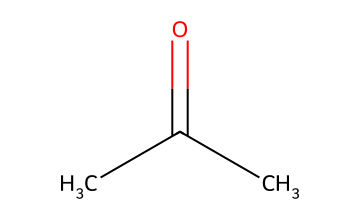
The molecule is a carbonyl group, C=O, with a methyl group on each side. That carbonyl is the reactive centre and the reason acetone behaves so differently from an alcohol of similar size.
Physical properties
| Property | Value |
|---|---|
| Appearance | Clear, colourless, mobile liquid |
| Odour | Sweet, pungent, characteristic |
| Boiling point | 56.05 °C |
| Melting point | About −95 °C |
| Density | 0.791 g/cm3 at 20 °C |
| Vapour pressure | About 24.6 kPa at 20 °C |
| Vapour density | 2.0 (air = 1) |
| Flash point | About −20 °C, closed cup |
| Autoignition temperature | About 465 °C |
| Explosive limits in air | Roughly 2.6 to 12.8 % by volume |
| Refractive index | 1.3588 at 20 °C |
| Solubility in water | Miscible in all proportions |
Note the vapour density of 2. Acetone vapour is twice as heavy as air, so it collects in pits, sumps and the bottom of a tank rather than dispersing upwards. That single number governs how a store room is ventilated.
Why acetone boils at 56 degrees C
Compare acetone with isopropyl alcohol. Both are three-carbon oxygenates of almost the same molecular weight, yet acetone boils at 56 °C and isopropanol at 82 °C. The difference is hydrogen bonding.
Isopropanol has an O–H group, so its molecules hydrogen bond to each other and hold the liquid together. Acetone has an oxygen that can accept a hydrogen bond but no hydrogen on oxygen to donate one, so acetone molecules cannot hydrogen bond to each other. They are held together only by dipole–dipole attraction, which is weaker, and the liquid gives up its molecules more easily.
The same asymmetry explains the next section.
Why it mixes with both water and solvents
Acetone is miscible with water in every proportion and also dissolves oils, waxes, resins and most polymers short of the highly crystalline ones. Very few solvents do both.
The carbonyl oxygen accepts hydrogen bonds from water, which handles the water side. The two methyl groups give the molecule a non-polar surface, which handles the organic side. The result is a solvent that bridges aqueous and organic systems, which is why it turns up as a coupling solvent, a cleaning solvent for water-wet parts, and a drying aid — rinse a wet component in acetone and the acetone carries the water away and then evaporates.
The practical limit is plastics. Acetone attacks polystyrene, ABS, polycarbonate and many acrylics, and swells or dissolves PVC. Test compatibility before using it near a plastic component.
How acetone is made
The overwhelming majority of the world's acetone is a co-product of phenol. In the cumene process, benzene and propylene are combined to make cumene, which is oxidised to cumene hydroperoxide and then cleaved with acid into phenol and acetone. Roughly 0.6 tonnes of acetone appear for every tonne of phenol.
That coupling has a commercial consequence worth knowing: the acetone price is driven as much by phenol demand as by acetone demand, because supply is set by someone else's production plan. A secondary route, catalytic dehydrogenation of isopropyl alcohol, is used where on-purpose acetone is wanted and tends to set a ceiling on the price.
Technical, AR, HPLC and pharmacopoeial grades
| Grade | Typical assay | What is additionally controlled |
|---|---|---|
| Technical / industrial | 99.0 to 99.5 % | Water, non-volatile residue, acidity, colour (APHA) |
| Analytical reagent (AR / ACS) | 99.5 %+ | Full trace metals, aldehydes, methanol, substances reducing permanganate |
| HPLC / spectroscopy | 99.8 %+ | UV absorbance cut-off, gradient elution test, very low residue |
| Pharmacopoeial (IP / BP / USP) | Per monograph | Related substances, methanol, residue on evaporation, identification tests |
The distinction that trips people up is AR versus HPLC. AR grade is clean by mass but is not tested for the thing that matters in chromatography — UV-absorbing impurities at parts-per-million level. Use AR in a chromatograph and you get baseline drift and ghost peaks even though the certificate says 99.5 %.
Scapex Exports supplies acetone technical grade, acetone AR grade and acetone HPLC grade.
What acetone is used for
- Solvent and cleaning. Degreasing metal, cleaning printing and coating equipment, stripping uncured resin, removing adhesive residue.
- Coatings and inks. A fast-evaporating component in lacquers, nitrocellulose systems and printing inks. In several jurisdictions acetone is exempt from VOC counting, which keeps it in formulations that would otherwise have moved on.
- Chemical intermediate. Feedstock for methyl methacrylate, bisphenol A, mesityl oxide, methyl isobutyl ketone and diacetone alcohol.
- Pharmaceutical processing. Crystallisation, granulation and washing solvent, recovered and controlled as a Class 3 residual solvent.
- Acetylene storage. Acetylene cylinders are packed with a porous mass saturated in acetone, which dissolves about 25 times its own volume of acetylene per atmosphere and lets the gas be stored safely.
- Cellulose acetate and fibre. Spinning solvent in acetate fibre and film production.
- Laboratory. Glassware rinsing and rapid drying.
Flammability, handling and export documents
Acetone is a Class 3 flammable liquid, UN 1090, packing group II. A flash point near −20 °C means the vapour above the liquid is ignitable at any ordinary ambient temperature, and the wide 2.6 to 12.8 % explosive range means a leak reaches an ignitable mixture quickly.
- Ignition control. Bond and earth drums and receiving vessels before transfer. Acetone flowing through a pipe generates static, and the vapour needs very little energy to ignite.
- Ventilation. Vapour is heavier than air. Extract at low level; do not rely on roof vents.
- Storage. Cool, shaded, well ventilated flammable store, away from oxidisers. Acetone reacts violently with strong oxidising agents, and with chloroform in the presence of a base.
- Health. Defatting to skin, eye irritation, and central nervous system depression at high vapour concentrations. Use nitrile or butyl gloves for short contact, splash goggles, and monitor the workplace exposure limit in force locally.
- Materials. Carbon steel and stainless steel are fine. Avoid natural rubber, EPDM, polystyrene, ABS, polycarbonate and many acrylics.
- Packing. 160 kg and 200 litre MS or epoxy-lined drums, IBCs, ISO tanks and bulk.
Acetone is a listed precursor chemical in several international control regimes, so some destinations require an import authorisation, an end-use declaration or pre-export notification. A compliant supplier will ask about end use and consignee before quoting; that is normal diligence, not obstruction.
An export consignment should carry a certificate of analysis stating assay, water, acidity, non-volatile residue and colour; a 16-section GHS safety data sheet; a dangerous goods declaration with UN 1090, Class 3, PG II; commercial invoice and packing list; certificate of origin; and any end-use or import permit the destination requires.
Enquire with a specification
Acetone is supplied by Scapex Exports as a manufacturer and supplier from qualified Indian producers, in technical, analytical reagent, HPLC and pharmacopoeial grades, with certificate of analysis, safety data sheet and full export and dangerous goods documentation.
Send the grade, assay, water limit, packing, quantity and destination port, together with the end use, and you will get a quotation written against that specification rather than a generic one.
Frequently asked questions
What is the formula of acetone?
The molecular formula is C3H6O and the structural formula is CH3-CO-CH3. It is the simplest ketone: a carbonyl carbon carrying two methyl groups. Its CAS number is 67-64-1 and its molecular weight is 58.08 g/mol. The IUPAC name is propan-2-one; dimethyl ketone and 2-propanone are the same substance.
What is the boiling point of acetone?
56.05 degrees C at atmospheric pressure, and it freezes at about minus 95 degrees C. The low boiling point is why acetone flashes off a surface in seconds, and why it must be stored in closed containers away from heat; at 20 degrees C its vapour pressure is already about 24.6 kPa.
What is the density of acetone?
About 0.791 g/cm3 at 20 degrees C, or 0.7845 g/cm3 at 25 degrees C. It is lighter than water, so an acetone spill on water spreads rather than sinking - although the two are miscible and will mix rather than remaining as layers.
What is the CAS number of acetone?
67-64-1. The EC number is 200-662-2 and the UN number for transport is 1090, Class 3, packing group II. The HS code is normally 2914.11.
Is HPLC grade acetone different from technical grade?
Only in purity, and the purity is the whole point. Technical acetone is controlled for assay, water and non-volatile residue. HPLC grade adds a UV cut-off specification and a gradient elution test, because a trace impurity that is invisible in a degreasing tank will produce a ghost peak in a chromatogram. AR grade sits between them with a full trace-element and residue profile.
What is acetone?
Acetone (CAS 67-64-1) is supplied as a clear colorless liquid, with the molecular formula C3H6O and a molecular weight of 58.08 g/mol. Its main applications include paints, adhesives and pharma extraction. Scapex Exports exports and supplies it from India in ≥99.5% Technical grade, with a batch Certificate of Analysis (COA) and MSDS.
What is acetone used for?
The main applications of Acetone are paints, adhesives and pharma extraction.
Where can you buy acetone?
You can buy Acetone from Scapex Exports, an exporter and supplier based in Ahmedabad, India. Send the grade, quantity and destination port with the Request a Quotation button on the product page and we will confirm availability, packing and price, with the COA and MSDS.
Is acetone flammable?
Yes, it should be handled as hazardous. The GHS classification in our product data for Acetone is: Flammable liquid. Hazard statements, handling precautions, PPE, storage and first-aid measures are given in the Material Safety Data Sheet (MSDS) linked on the product page.
Is acetone water soluble?
Our product data gives the solubility of Acetone as: miscible with water.