
The short answer
Benzaldehyde is the simplest aromatic aldehyde. Structure C6H5CHO, molecular formula C7H6O, CAS 100-52-7, molecular weight 106.12 g/mol, boiling point 178 °C. It is a colourless to pale yellow oily liquid with a strong bitter almond odour.
Two things define it commercially. It is the backbone of almond and cherry flavour and a large family of fragrance and pharmaceutical intermediates. And it oxidises in air faster than almost any other bulk aromatic, which makes storage and packing a real part of the specification rather than an afterthought.
Structure, molecular weight and identifiers
| Property | Value |
|---|---|
| Structural formula | C6H5CHO |
| Molecular formula | C7H6O |
| IUPAC name | Benzaldehyde |
| CAS number | 100-52-7 |
| EC number | 202-860-4 |
| Molecular weight | 106.12 g/mol |
| FEMA number | 2127 |
| HS code | 2912.21 |
| Other names | Benzoic aldehyde, phenylmethanal, artificial bitter almond oil |
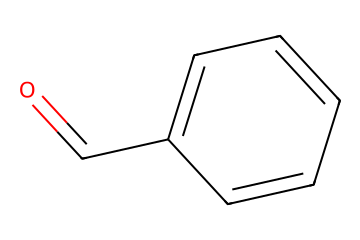
The aldehyde group sits directly on the ring, so the carbonyl and the aromatic system are conjugated. That conjugation stabilises the molecule, which is why benzaldehyde does not undergo the aldol self-condensation that an aliphatic aldehyde would — it has no alpha hydrogen — and why it takes part in the classic Cannizzaro and benzoin reactions instead.
Physical properties
| Property | Value |
|---|---|
| Appearance | Clear, colourless to pale yellow oily liquid |
| Odour | Strong, characteristic bitter almond |
| Boiling point | 178 to 179 °C |
| Melting point | About −26 °C |
| Density | 1.044 g/cm3 at 25 °C |
| Refractive index | About 1.545 at 20 °C |
| Flash point | About 63 °C, closed cup |
| Solubility in water | Slight, roughly 6 to 7 g/L at 20 °C |
| Miscibility | Miscible with ethanol, ether and most organic solvents |
| Vapour pressure | About 0.13 kPa at 26 °C |
Note the density above 1. Benzaldehyde is heavier than water, so in a two-phase system it forms the lower layer — the opposite of most aromatic solvents and an easy mistake to make during work-up.
Why benzaldehyde turns into benzoic acid
Left in contact with air, benzaldehyde autoxidises to benzoic acid. The reaction is a free radical chain: oxygen abstracts the aldehyde hydrogen to give an acyl radical, that adds oxygen to form a peroxy acid, and the peroxy acid oxidises another molecule of benzaldehyde. Because each cycle generates the radical that starts the next, the reaction accelerates once it begins.
What you see is white crystalline solid in the drum or on the closure, a rising acid value, and a flattened almond note in the finished flavour. Light and trace metals both catalyse it.
The controls that actually work:
- Exclude air. Nitrogen blanket on the drum or tank, and the container kept as full as practical. Headspace is where the reaction lives.
- Exclude light and metal. Amber glass, lined or stainless steel; not bare mild steel, and not copper.
- Stabilise where permitted. Technical and fragrance grades are frequently supplied with a small antioxidant addition. Food and pharmacopoeial grades often cannot be, so they are shipped under nitrogen and have a shorter practical shelf life.
- Buy to consumption. A part-used drum deteriorates far faster than a sealed one. Order in a pack size you will finish.
Check the acid value on receipt and again before use. It is the single most informative number on a benzaldehyde certificate.
Natural versus synthetic benzaldehyde
Benzaldehyde occurs naturally in bitter almond, apricot, peach and cherry kernels, bound as the glycoside amygdalin. Crushing and enzymatic hydrolysis release benzaldehyde, glucose and hydrogen cyanide — which is why crude bitter almond oil has to be purified before food use, and why the cyanide-free grade is specified explicitly.
Natural and synthetic benzaldehyde are the same molecule. No assay, chromatogram or spectrum will separate them. What separates them is provenance, and the analytical proof of provenance is isotopic: carbon-14 content distinguishes recently-grown biological carbon from petrochemical carbon, and site-specific isotope ratio analysis distinguishes botanical routes from one another.
If your label claims natural flavour, you need a natural-source certificate and the isotope data behind it, and you should expect to pay a multiple of the synthetic price for a chemically indistinguishable product. If it does not, synthetic is the rational choice.
How benzaldehyde is made
Two industrial routes dominate, both starting from toluene.
- Chlorination and hydrolysis. Toluene is chlorinated at the side chain to benzal chloride, which is hydrolysed to benzaldehyde. High yielding, but the product can carry trace chlorinated impurities, which is why chlorine-free benzaldehyde is a distinct and separately specified grade.
- Direct oxidation. Toluene is oxidised in the liquid or vapour phase. It avoids chlorine entirely but the aldehyde is an intermediate on the way to benzoic acid, so selectivity and conversion have to be traded off against each other.
Natural benzaldehyde is produced by hydrolysing amygdalin from kernels, or by retro-aldol cleavage of cinnamaldehyde obtained from cassia oil — the latter being the usual commercial source of natural material.
Commercial grades and what separates them
| Grade | Typical assay | What is additionally controlled |
|---|---|---|
| Technical | 99 %+ | Acid value, colour, water |
| Chlorine-free / FCC | 99 %+ | Chlorinated compounds, benzoic acid, acid value, odour profile |
| Food / flavour (FCC, FEMA 2127) | 98 to 99 %+ | Heavy metals, cyanide absent, refractive index, specific gravity, sensory evaluation |
| Natural | 99 %+ | Botanical origin certificate plus carbon-14 and isotope ratio data |
| Analytical reagent | 99.5 %+ | Full impurity profile, typically stabilised and supplied under inert gas |
Scapex Exports supplies benzaldehyde 99+% and the related acetal, benzaldehyde dimethyl acetal, which is used where the free aldehyde would be too reactive or too unstable in the finished formulation.
What benzaldehyde is used for
- Flavour. Almond, cherry, marzipan and stone-fruit notes in confectionery, bakery, beverages and pharmaceutical syrups. It is one of the highest-volume single flavour chemicals in use.
- Fragrance. An almond top note in its own right and a building block for the cinnamic and heliotropin families.
- Chemical intermediate. Route to cinnamaldehyde and cinnamic acid by Perkin condensation, to benzyl alcohol and benzoic acid by Cannizzaro, to benzoin, mandelic acid and benzyl benzoate, and to a range of dye and agrochemical intermediates.
- Pharmaceutical synthesis. Starting material in several established syntheses, including chloramphenicol and ephedrine chemistry.
- Aniline dyes. Long-standing use in triphenylmethane dye manufacture.
- Analytical and laboratory. Derivatising reagent and a standard substrate in aldehyde chemistry teaching and method development.
Handling, storage and export documents
- Classification. Benzaldehyde appears in the dangerous goods lists as UN 1990, Class 3, packing group III, notwithstanding a closed-cup flash point of about 63 °C. Confirm the classification in force for your mode and destination with your forwarder before booking, because treatment varies between regimes.
- Health. Harmful if swallowed; irritating to skin and eyes. Use nitrile gloves, splash goggles and local exhaust ventilation. The odour is detectable far below any harmful level, so smelling it is not in itself an exposure alarm.
- Fire. Combustible liquid. Keep away from heat, sparks and oxidising agents. Peroxy intermediates formed during autoxidation add a further reason to avoid heating aged material.
- Materials. Stainless steel, lined mild steel, HDPE and amber glass. Avoid bare mild steel, copper and copper alloys, which catalyse oxidation and discolour the product.
- Packing. 200 to 220 kg lined or stainless drums, 25 kg carboys, or amber glass for reagent quantities, nitrogen blanketed.
- Regulatory. Benzaldehyde is a monitored chemical in several jurisdictions because of its position in certain pharmaceutical syntheses. A compliant supplier will ask for end use and consignee details, and some destinations require an import permit or end-use declaration.
An export consignment should carry a certificate of analysis stating assay, acid value, colour (APHA), refractive index, specific gravity, water and chlorinated compounds; a 16-section GHS safety data sheet; a dangerous goods declaration where the destination requires one; commercial invoice and packing list; certificate of origin; and for food grade the FCC or FEMA reference with heavy-metal limits and any Halal, Kosher or allergen declarations required.
Enquire with a specification
Benzaldehyde is supplied by Scapex Exports as a manufacturer and supplier from qualified Indian producers, in technical, chlorine-free, food and flavour grades, nitrogen blanketed and packed for the shelf life your process needs, with certificate of analysis, safety data sheet and full export documentation.
Send the grade, assay, acid value limit, chlorine requirement, natural or synthetic status, packing and destination port together with the end use, and you will get a quotation written against that specification rather than a generic one.
Frequently asked questions
What is the molecular weight of benzaldehyde?
106.12 g/mol. The molecular formula is C7H6O, usually written C6H5CHO to show the structure, and the CAS number is 100-52-7. It is the simplest aromatic aldehyde: a benzene ring carrying a single CHO group.
What is the density of benzaldehyde?
About 1.044 g/cm3 (1.044 g/mL) at 25 °C, so it is slightly denser than water. It boils at 178 to 179 °C and melts at about −26 °C.
What is the structure of benzaldehyde?
A benzene ring with an aldehyde group attached directly to it - C6H5-CHO. The carbonyl is conjugated with the aromatic ring, which is what makes benzaldehyde less reactive than an aliphatic aldehyde of similar size and gives it its characteristic ultraviolet absorption.
Why does benzaldehyde smell of almonds?
Because it is the compound responsible for that smell in nature. Bitter almonds, apricot and cherry kernels contain amygdalin, which breaks down enzymatically on crushing to release benzaldehyde, glucose and hydrogen cyanide. Commercial benzaldehyde carries the almond note without the cyanide, which is removed or never formed depending on the route.
Why does benzaldehyde go off in storage?
It oxidises in air to benzoic acid. Aldehydes are easily oxidised, and benzaldehyde is unusually prone to it because the reaction goes through a self-propagating free radical chain. White crystals of benzoic acid appearing in a part-used drum are the visible result. Storage under nitrogen in a full, sealed, lined or amber container is the standard control.
Is natural benzaldehyde chemically different from synthetic?
No. The molecule is identical and a normal purity test cannot tell them apart. The distinction is legal and commercial: natural benzaldehyde must be derived from a botanical source to be labelled natural in food, and it is verified by carbon-14 and stable isotope ratio analysis rather than by conventional assay. Expect a substantial price difference for the same assay figure.
What is benzaldehyde?
Benzaldehyde (CAS 100-52-7) is supplied as a colorless liquid, with the molecular formula C7H6O and a molecular weight of 106.12 g/mol. Its main applications include almond flavour and fragrance note. Scapex Exports exports and supplies it from India in 99% min grade, with a batch Certificate of Analysis (COA) and MSDS.
Is benzaldehyde soluble in water?
Our product data gives the solubility of Benzaldehyde as: in water, 6950 mg/L at 25 °C.