
The short answer
Isobutyl alcohol is the branched four-carbon primary alcohol. IUPAC name 2-methyl-1-propanol, structure (CH3)2CHCH2OH, formula C4H10O, CAS 78-83-1, molecular weight 74.12 g/mol, boiling point 108 °C.
It is a clear, flammable liquid with a mild alcoholic odour, only partly soluble in water and miscible with most organic solvents. Commercially it is the cheaper companion to n-butanol from the same plant, and it is specified where a slightly faster evaporation and a lower price are worth more than n-butanol's marginally better flow and gloss.
Structure, formula and identifiers
| Property | Value |
|---|---|
| Structural formula | (CH3)2CHCH2OH |
| Molecular formula | C4H10O |
| IUPAC name | 2-Methyl-1-propanol |
| CAS number | 78-83-1 |
| EC number | 201-148-0 |
| Molecular weight | 74.12 g/mol |
| UN number | UN 1212, Class 3, PG III |
| HS code | 2905.14 |
| Other names | Isobutanol, IBA, isopropyl carbinol, 2-methylpropan-1-ol |
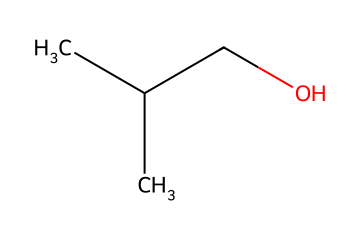
The branch matters chemically. Because the hydroxyl still sits on a carbon attached to only one other carbon, isobutanol is a primary alcohol and oxidises cleanly to isobutyraldehyde and then isobutyric acid, and esterifies readily — behaviour tert-butanol does not share.
The four butanol isomers
| Isomer | Structure | CAS | Boiling point | Class |
|---|---|---|---|---|
| n-Butanol | CH3(CH2)3OH | 71-36-3 | 117.7 °C | Primary, straight chain |
| Isobutanol | (CH3)2CHCH2OH | 78-83-1 | 107.9 °C | Primary, branched |
| sec-Butanol | CH3CH(OH)CH2CH3 | 78-92-2 | 99.5 °C | Secondary |
| tert-Butanol | (CH3)3COH | 75-65-0 | 82.4 °C | Tertiary |
Notice the pattern: the more branched the molecule, the lower the boiling point. Branching makes the molecule more compact and reduces the surface available for the van der Waals attraction between neighbours, so less energy is needed to separate them. The hydroxyl group's hydrogen bonding is the same in all four; only the shape changes.
The practical reading of that table is an evaporation ladder. If a formulation is drying too slowly with n-butanol, isobutanol is the natural step; if it is drying too fast and blushing, n-butanol is the step back.
Physical properties
| Property | Value |
|---|---|
| Appearance | Clear, colourless liquid |
| Odour | Mild, characteristic alcoholic |
| Boiling point | 107.9 °C |
| Melting point | About −108 °C |
| Density | About 0.802 g/cm3 at 20 °C |
| Flash point | About 28 °C, closed cup |
| Autoignition temperature | About 415 °C |
| Explosive limits in air | Roughly 1.7 to 10.9 % by volume |
| Solubility in water | About 8.5 g per 100 mL at 20 °C |
| Refractive index | About 1.396 at 20 °C |
| Vapour density | 2.6 (air = 1) |
Why it behaves as it does in a coating
Isobutanol is a hydrogen-bonding solvent with a four-carbon hydrocarbon tail, which puts it in a useful middle position. It dissolves nitrocellulose only weakly on its own but is an excellent latent solvent — add it to an ester or ketone system and the mixture dissolves more resin than either component would alone.
Its most important role is in amino resin coatings. Melamine–formaldehyde and urea–formaldehyde resins are butylated with n-butanol or isobutanol, and using the same alcohol as the solvent keeps the resin stable in the can and controls the cure. Isobutanol-butylated systems are widely used in stoving and coil enamels for exactly this reason.
Two further points that decide formulations. Isobutanol breaks the hydrogen-bonded structure of water, so a small addition suppresses blushing in humid spray conditions. And because it is only partly water-soluble, it can be recovered from aqueous process streams by phase separation, which fully miscible alcohols make impossible.
How isobutanol is made
The great majority of isobutanol is a co-product of the oxo process. Propylene, carbon monoxide and hydrogen are combined over a catalyst to give a mixture of n-butyraldehyde and isobutyraldehyde, and each is hydrogenated to the corresponding alcohol. Modern low-pressure rhodium catalysts push the ratio strongly toward the straight chain, so isobutanol is the minor product.
That has a commercial consequence worth knowing. Isobutanol supply is set by how much n-butanol the market wants, not by demand for isobutanol itself, so its price relative to n-butanol moves with the n:iso ratio the producers are running. Fermentation routes to isobutanol exist and are used at small scale, mainly where a bio-based certificate is required.
Commercial grades and what separates them
| Grade | Typical assay | What is controlled |
|---|---|---|
| Technical / industrial | 99.0 to 99.5 % | Water, acidity, colour (APHA), non-volatile residue, n-butanol content |
| Coatings grade | 99.5 %+ | As above plus odour and distillation range |
| Analytical reagent | 99.5 %+ | Full impurity profile, tight water limit |
The specification line that matters most in a coating is the water content. Water in isobutanol upsets the equilibrium in a butylated amino resin system and shows up as haze in the can or as poor flow on the panel. Ask for the Karl Fischer figure on the certificate, not just a tick against “passes test”.
Scapex Exports supplies isobutanol in technical and coatings grades.
What isobutyl alcohol is used for
- Coatings. Solvent and co-solvent in nitrocellulose lacquers, alkyds, epoxy esters and especially amino resin stoving and coil enamels; blush retarder in humid spray conditions.
- Resin butylation. The alcohol used to butylate melamine and urea formaldehyde resins, which controls their solubility and cure behaviour.
- Esters. Raw material for isobutyl acetate, a fast solvent for coatings and inks, and for isobutyl esters used as plasticisers, lubricant additives and fragrance materials.
- Printing inks and adhesives. Solvent and viscosity modifier.
- Extraction and processing. Extraction solvent in pharmaceutical and fine chemical work, where partial water solubility allows clean phase separation.
- Mineral processing. Frother in flotation circuits.
- Cleaning and de-icing. Component of industrial cleaners, and of some de-icing and anti-icing formulations.
Flammability, handling and export documents
- Classification. Flammable liquid, UN 1212, Class 3, packing group III. A flash point near 28 °C means that on a warm day the headspace of a drum can be within the flammable range.
- Ignition control. Bond and earth drums and receiving vessels; vapour is 2.6 times heavier than air and collects at low level, so extract at floor level rather than through the roof.
- Health. Irritating to eyes and respiratory tract; may cause drowsiness at high vapour concentrations; defatting to skin on repeated contact. Nitrile gloves, splash goggles and good ventilation.
- Segregation. Keep away from strong oxidisers, acid chlorides and acid anhydrides. Like all alcohols it reacts vigorously with alkali metals.
- Materials. Carbon steel, stainless steel, PTFE and Viton are suitable. Avoid natural rubber and some polyurethane and polyamide components.
- Packing. 160 kg and 200 litre MS or lined drums, IBCs, ISO tanks and bulk.
An export consignment should carry a certificate of analysis stating assay, water by Karl Fischer, acidity as acetic acid, colour (APHA), distillation range, non-volatile residue and n-butanol content; a 16-section GHS safety data sheet; a dangerous goods declaration with UN 1212, Class 3, PG III; commercial invoice and packing list; and certificate of origin.
Enquire with a specification
Isobutanol is supplied by Scapex Exports as a manufacturer and supplier from qualified Indian producers, in technical, coatings and analytical grades, with certificate of analysis, safety data sheet and full export and dangerous goods documentation.
Send the grade, assay, water limit, packing, quantity and destination port, and you will get a quotation written against that specification rather than a generic one.
Frequently asked questions
What is the structure of isobutyl alcohol?
Isobutyl alcohol is 2-methyl-1-propanol: (CH3)2CH-CH2-OH. A three-carbon propane chain carries a methyl branch on the middle carbon and the hydroxyl group on an end carbon. It is therefore a branched primary alcohol - primary because the carbon bearing the OH is attached to only one other carbon.
What is the formula and molecular weight of isobutanol?
The molecular formula is C4H10O and the molecular weight is 74.12 g/mol. The CAS number is 78-83-1 and the UN number for transport is 1212, Class 3, packing group III. The HS code is normally 2905.14.
What is the difference between butanol and isobutanol?
They are structural isomers - same formula C4H10O, different arrangement. n-Butanol is the straight chain and boils at 118 degrees C; isobutanol is branched and boils at 108; sec-butanol boils at about 99.5 and tert-butanol at 82 and is solid just below room temperature. The branching lowers the boiling point and changes solvency, evaporation rate and the ester made from each.
What is the boiling point of isobutyl alcohol?
About 107.9 degrees C, with a melting point near minus 108 degrees C and a closed cup flash point of about 28 degrees C. That flash point is the number that governs storage: it is below normal warm ambient temperatures in much of the world, so isobutanol is handled as a flammable liquid.
Is isobutanol miscible with water?
Only partially. About 8.5 g dissolves in 100 mL of water at 20 degrees C, so above that a separate organic layer forms - and because isobutanol is lighter than water, it sits on top. That limited solubility is useful: it allows isobutanol to be used in extraction and to be recovered from aqueous streams, which fully water-miscible alcohols like ethanol do not permit.
What is Isobutanol?
Isobutanol (CAS 78-83-1) is supplied as a clear colorless liquid, with the molecular formula C4H10O and a molecular weight of 74.12 g/mol. Its main applications include coatings and chemical intermediates. Scapex Exports exports and supplies it from India in ≥99.0% Technical grade, with a batch Certificate of Analysis (COA) and MSDS.
What is Isobutanol used for?
The main applications of Isobutanol are coatings and chemical intermediates.